
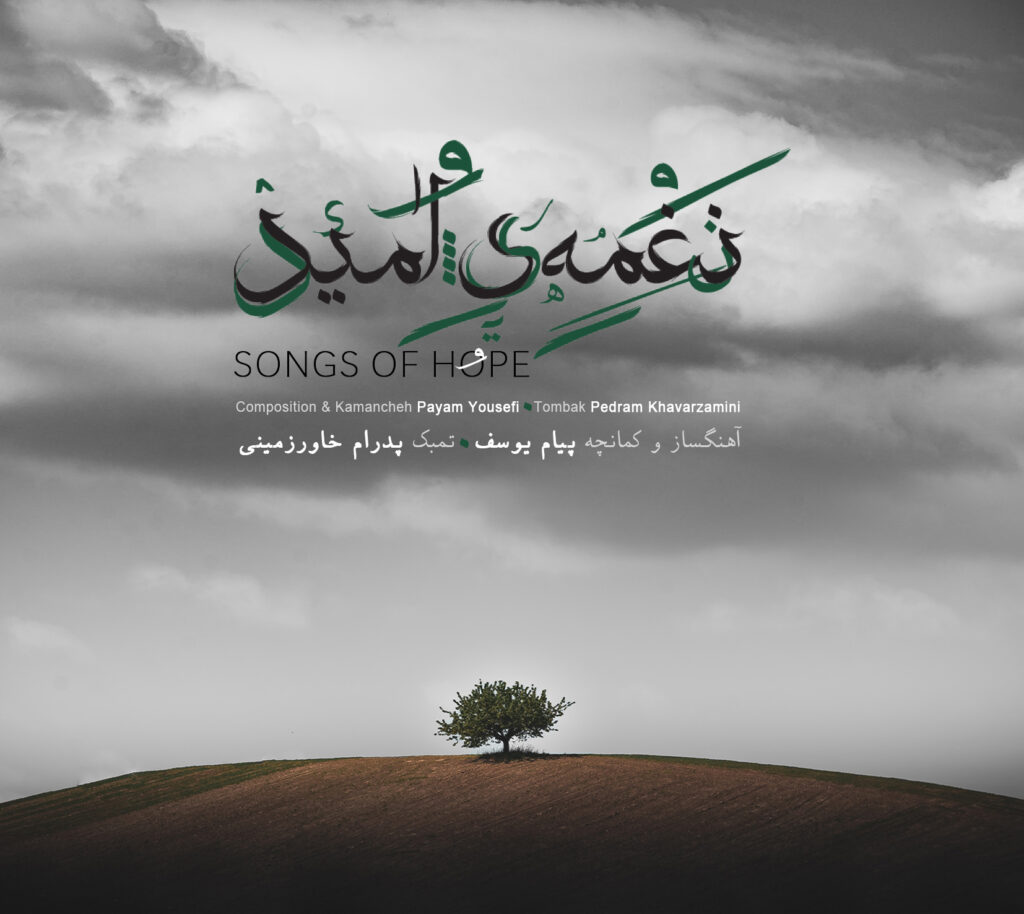
Songs of Hope released in January of 2025. This debut solo album consists of improvisations on the kamancheh and new compositions for the kamancheh and tombak. Featuring the masterful accompaniment of percussionist Pedram Khavarzamini this album explores the chahargah and segah melodic modes of classical Persian Music while drawing heavily on the vocal avaz tradition.
Available now on all streaming platforms, and available for purchase of digital and physical copy here
“Songs of Hope” (released January 2025) is a full-length kamâncheh album rooted in the ancient Persian dastgâh/maqâm tradition. Showcasing the original compositions and improvisations of Dr. Payam Yousefi across ten tracks, it stands among the few concert-length works that feature the kamâncheh as a standalone melodic instrument. The album is further enriched by the rhythmic artistry of Pedram Khavarzamini, one of Iran’s most renowned tombak virtuosos.
In this album, Yousefi presents a unique style that merges traditional idioms, intonations, and forms with modern performance techniques. The result is contemporary pieces that are melodically novel yet deeply rooted in the subtle nuances of the dastgâh/maqâm tradition. Notably, Yousefi demonstrates a rare ability to explore the highest registers and positions on the kamâncheh through complex melodies, intricate ornament clusters, and virtuosic passages. The album also introduces new modal-modulatory schemes and two innovative asymmetrical rhythmic cycles, heard in Track 4, “Emerald’s Dance,” and Track 8, “Euphoric.”
This innovative approach within tradition reflects Yousefi’s rich musical heritage. As a student of some of Iran’s most esteemed master musicians, he carries forward two prominent musical lineages—drawing from his extensive studies in the vocal âvâz tradition with Ustad Masoumeh Mehrali (one of the few authoritative purveyors of maktab-e Shajarian) and the contemporary kamâncheh performance style of Ustad Ardeshir Kamkar. In this album, Yousefi masterfully intertwines these musical lineages, using ancient Persian poetic meters as frameworks for melodically rich free improvisations—an intricate and precise art form that is increasingly being lost.
Adding to its novelty, “Songs of Hope” was composed and recorded over a 40-day period, following an immersive, spiritually rooted creative process inspired by Sufi thought and philosophy. More than a collection of compositions, it is a journey through affective melodies and a testament to improvisatory and inventive mastery within the fading knowledge of modal dastgâh/maqâm performance idioms. While the work exists in the studio, its truest form emerges on stage, positioning “Songs of Hope” as a unique contribution to today’s music market—presenting fresh new repertoire and expanding the often-neglected ancient tradition of Persian music.